
Working Principle of Gas Permeability Analyzers: Labthink’s Guide to Accurate Barrier Measurement
Understanding the working principle of a gas permeability analyzer is crucial for selecting the right instrument for your quality control and R&D needs. We know that accurate gas barrier data is essential for ensuring product shelf life, performance, and safety. Our technical overview explains the core scientific principles behind these measurements. This knowledge helps you make informed decisions for your material testing requirements.
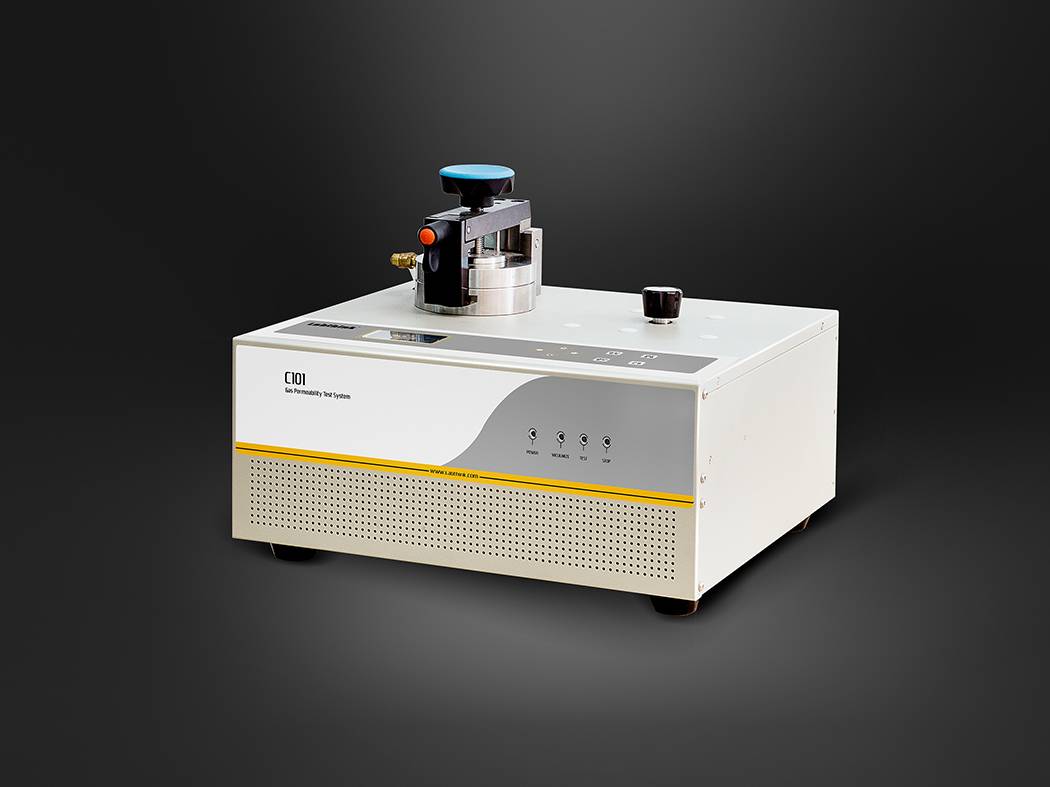
Gas Permeation Measurement Principle
The fundamental principle involves creating a controlled gas pressure differential across a test specimen. The specimen is mounted to form a sealed barrier between two chambers: a high-pressure upstream side and a low-pressure downstream side. The test gas is introduced to the upstream side at a specific pressure and temperature. As gas molecules permeate through the material, they accumulate in the downstream chamber, causing a measurable increase in pressure. By monitoring this pressure rise over time until it reaches a steady-state, the instrument calculates the specific Gas Transmission Rate (GTR). This method allows for the precise quantification of a material’s barrier properties under standardized conditions, providing critical data for industries like packaging and pharmaceuticals where gas ingress or egress must be controlled.
Gas Transport Mechanism Analysis
Gas transport through non-porous polymers primarily occurs via a solution-diffusion mechanism. This process involves three stages: adsorption, diffusion, and desorption. Gas molecules first dissolve into the polymer matrix on the high-pressure surface. They then diffuse through the material driven by the concentration gradient, moving randomly through intermolecular spaces. Finally, the molecules desorb from the low-pressure surface. The rate of this process depends on factors like gas molecule size, polymer chain mobility, and intermolecular forces. Understanding this mechanism is key to interpreting permeability data, as explained by resources from Labthink. This analysis helps in developing materials with tailored barrier properties for specific applications.
Permeability Coefficient Determination Method
The permeability coefficient is a fundamental material property calculated from the measured gas transmission rate. It is a product of the solubility and diffusion coefficients, representing the volume of gas that permeates per unit time, through a unit area of material, under a unit pressure differential. After the steady-state gas flow is established, data on the transmission rate, material thickness, and applied pressure difference are collected. These values are inserted into a standardized formula to compute the permeability coefficient. This intrinsic property allows for the direct comparison of barrier performance between different materials, independent of sample thickness, which is vital for material selection and development in research and industrial applications.
Conclusion
We at Labthink manufacture a series of Gas Permeability Testers. These instruments measure the gas transmission rate, often using the differential pressure method, and the oxygen transmission rate using the coulometric sensor method. Our product line includes models for testing common, toxic, flammable, or explosive gases, as well as specialized testers for materials like lithium-ion battery separators. Several of our models support ASTM gas permeability testing standards, providing reliable data for your quality assurance. For detailed specifications on our gas permeability analyzer, we invite you to explore our technical resources.